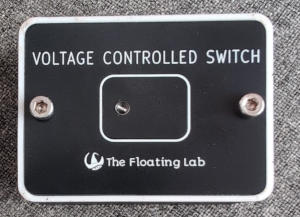
Automatically turn devices on when power is available — and off when it’s not.
Use excess solar energy, protect your batteries, and automate your onboard systems without complexity.
Typical uses
- Run equipment only when batteries are full
- Charge devices without draining your system
- Shut down loads before batteries get too low
Features
- Automatic and manual control
- Works with 12V and 24V systems
- Fully configurable voltage thresholds
- Can be used for high side and low side switching
- Can control DC loads up to 20 Amps
- Can control AC loads (110V-240V) with optional electronic relay
- Overvoltage protection
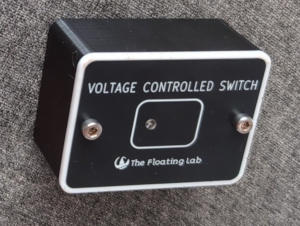
- Suitable for panel mount as well as in its own enclosure
How it works
Use it as a normal (touch) switch or as an automatic switch.
In automatic mode: Turns ON when voltage is high (charging), turns OFF when voltage drops
Real world examples
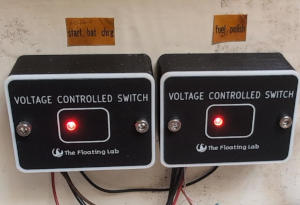
The purpose is best illustrated by some real world examples.
Fuel polisher
I use a voltage controlled switch to automatically run the pump of the fuel polisher, once the batteries are charged and excess energy from the solar panels is still available. Rather than throwing this energy away, why not use it to pump the fuel from the tank through a fine filter and back into the tank, over and over again?
Chargers
I have various items that I want to recharge when power is available, but not by draining the house battery. Think about the chargers of various tools like cordless drills, or the batteries of your e-bike, drone, etc. You don't want to tap into your energy reserve for that but rather recharge it when the solar panels are providing power or when the generator is running. You can use individual Voltage Controlled Switches for that or create a dedicated "charge bus" to which all chargers are connected. And if I am in a hurry and want to recharge right now, I just press the touch button to override the automatic switchover.
Starlink
I have a voltage controlled switch to power down the Starlink system when the batteries are becoming too empty, just to conserve the last 20% of power for more important things. Again, I can still use the touch button to override this behaviour.
Starter battery charging
I no longer have the alternators of my engines connected to the starter batteries. Instead, the output of the alternators goes to the house bank. And only once the house bank is reasonably full, a voltage controlled switch connects the starter battery to the house battery (and disconnects it again when the voltage starts to drop). This way, the starter battery gets a fresh recharge often, even when the engines are not used for months, but only after the house bank has received a charge. (A typical starter battery holds enough charge to start the engines a few dozen times, and doesn't need to be recharged immediately after a single start).
Indication lamp
As a boat owner, my crew often asks "Are the batteries full enough to use {some heavy consumer}". You can use a Voltage Controlled Switch just to show an indication light that shows whether it is ok to use that heavy consumer.
More information
Documentation (Usage & Installation)
Consult the Documentation for more information about the installation and usage of the Voltage Controlled Switch.
Project background
For more information about the general design philosophy of the projects of TheFloatingLab, please visit the Project Backgrounds page.
Ordering
The Voltage Controlled Switch can be bought as a completely assembled version, or as a kit (some soldering required).
The completely assembled version costs 49 USD, the kit version 44 USD. This is the panel mount version which does not include an enclosure.
Options
- Wall mount enclosure, 5 USD
- Cabinet mount enclosure, 5 USD
- Electronic relay (for 110V-240V AC operation) with enclosure, 69 USD
Ordering information will be available soon. If you are in a hurry, contact me.
Specifications
| Voltage: | 8-30V |
| Output: | 20A |
| Consumption: | <1mA when off, <3mA when on. |
| Voltage accuracy: | +/-0.1V |
| Front panel dimensions: | 55 x 40mm |
| Required panel cut out: | 40 x 30mm |